
Research & Impact
Evidence of Learning: What Happens When Students Investigate Mathematics
Su-Art Mathematics Learning Systems are used in more than 350 schools across India. This page documents what schools, teachers and students have reported — and what the evidence shows about the impact of hands-on, investigative mathematics learning.
350+
Schools Served
21
Hands-on Apparatuses
100+
Structured Investigations
30+
Mathematical Concepts
The educational context
Why Evidence Matters in Mathematics Education
Mathematics is among the subjects where the gap between classroom instruction and genuine understanding is most visible. Students can reproduce procedures without understanding why they work — and this gap tends to widen as concepts become more abstract in Classes VII through X.
Su-Art Mathematics Learning Systems were designed to address this gap through structured, hands-on investigation. The question the research asks is straightforward: does giving students the opportunity to investigate mathematical concepts for themselves — rather than receiving them through instruction — produce measurably better outcomes?
The findings documented here draw on school-level observations, teacher feedback and student outcome data collected from schools using Su-Art systems. They are presented factually, without extrapolation beyond what the evidence supports.
Research findings
What the Evidence Shows
The educational case for inquiry-based mathematics learning is well established in the research literature. What Su-Art adds is a structured, curriculum-aligned system that makes this approach practical for schools — with the apparatus, activity design and teacher support needed to implement it consistently and at scale. The findings below reflect outcomes reported by schools using Su-Art Mathematics Learning Systems.
Score improvement
40%
Average improvement in test scores
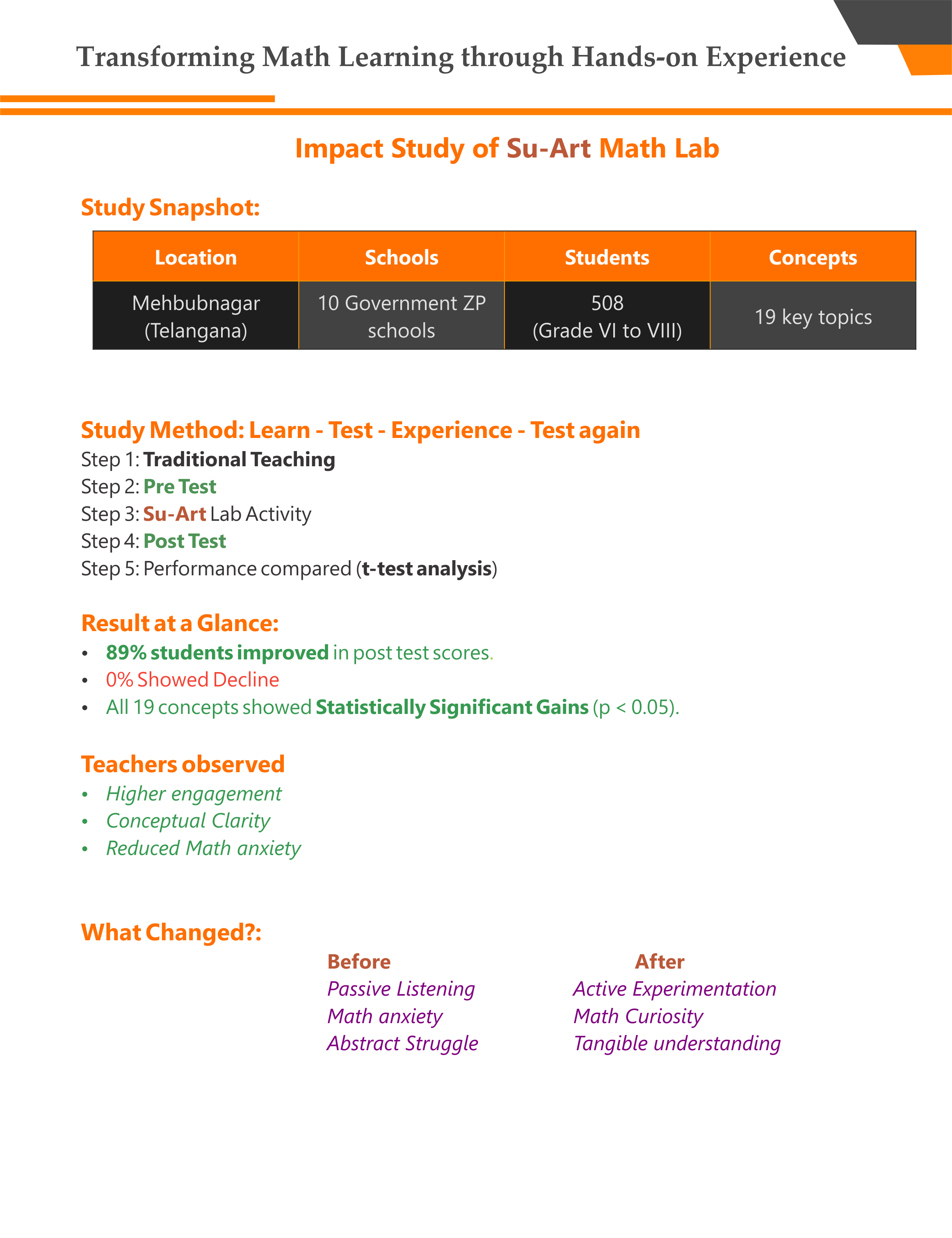
Schools using Su-Art Mathematics Learning Systems report average score improvements of 40% within one academic year of implementation.
Student engagement
85%
Students report increased engagement
85% of students in schools using Su-Art systems report increased interest and engagement in mathematics — a consistent finding across different school types and class levels.
Concept retention
3×
Better concept retention
Concepts developed through structured investigation are retained three times longer than those learned through rote instruction — a finding consistent with the broader research literature on inquiry-based learning.
Teacher outcomes
92%
Teacher satisfaction rate
92% of teachers using Su-Art systems report that structured investigations make their lessons more effective and their students more engaged in mathematics.
About These Findings
The findings on this page are drawn from school-level feedback, teacher surveys and student outcome data collected from schools using Su-Art Mathematics Learning Systems across India. They reflect the experience of schools that have implemented the systems as part of their Mathematics Laboratory or classroom programme. Su-Art presents these findings as evidence of impact — not as the results of a controlled randomised trial. The consistency of outcomes across different school types and geographies is, however, a meaningful indicator of the approach's effectiveness.
Why the approach works
The Investigative Learning Difference
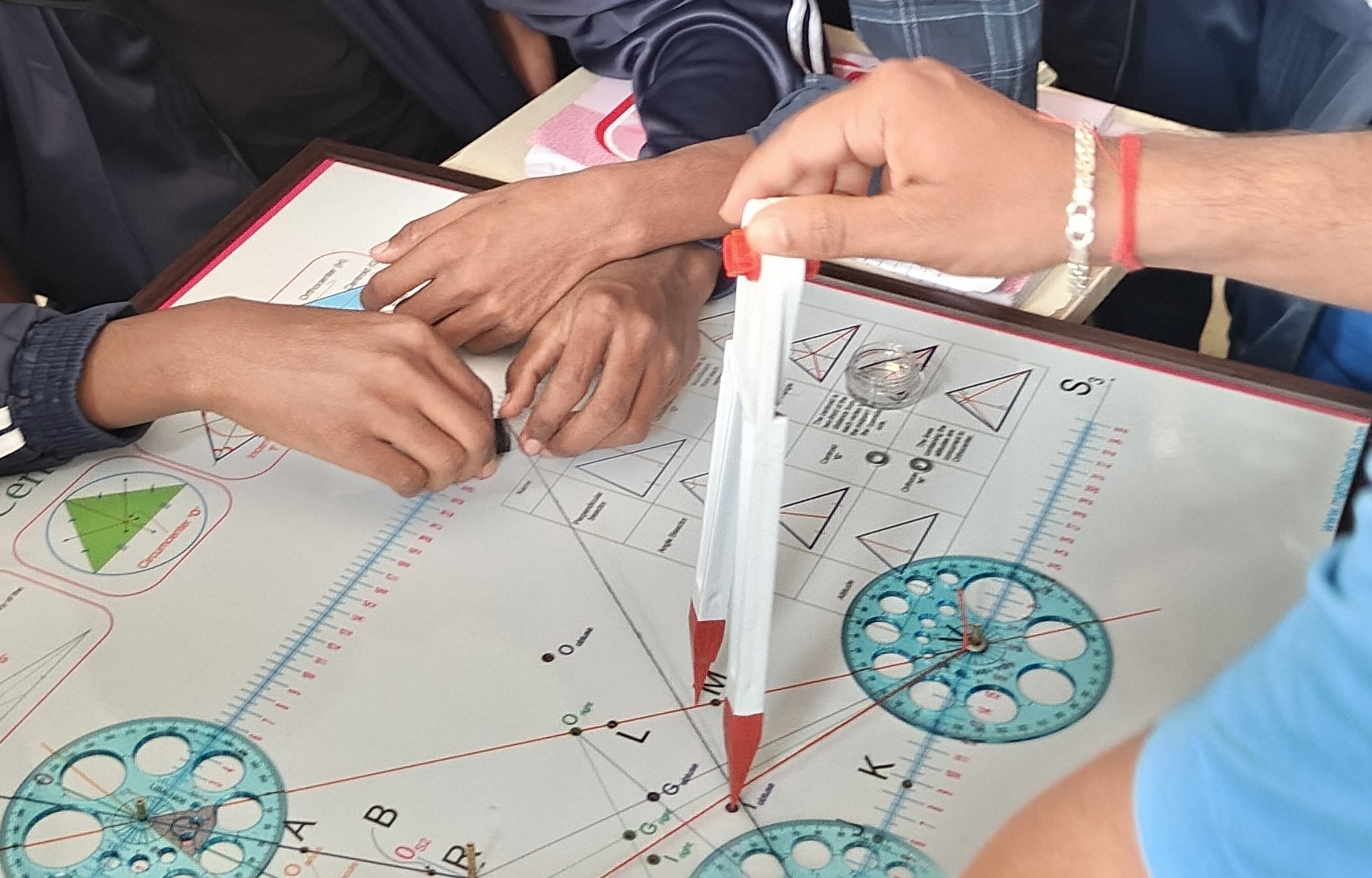
The research findings above are not accidental. They reflect a specific pedagogical mechanism: when students investigate a mathematical concept for themselves — forming a hypothesis, gathering evidence, recording observations and drawing their own conclusions — they develop a qualitatively different kind of understanding from students who receive the same concept through instruction.
Students own their conclusions
A student who has verified the Pythagoras Theorem by measuring, comparing and confirming the relationship across multiple right triangles does not need to memorise it. The theorem is a conclusion they reached — not a fact they were told.
Errors become learning events
When a student's hypothesis is wrong, the apparatus shows them why. This is qualitatively different from being told the correct answer. The experience of revising a hypothesis based on evidence is itself a mathematical skill.
Concepts transfer more readily
Understanding built through investigation transfers more readily to unfamiliar problems. Students who understand why the Basic Proportionality Theorem is true — not just what it states — are better equipped to apply it in contexts they have not seen before.
Teachers facilitate rather than transmit
The structured investigation format changes the teacher's role from transmitter of information to facilitator of enquiry. Teachers report that this shift — guided by the Operation Manual — makes their lessons more engaging for both students and themselves.
From schools using Su-Art
What Educators Report
After installing the Su-Art Math Lab, our Class 9 and 10 board results improved significantly. Students who previously struggled with geometry now approach it with genuine confidence.
Principal
Principal
CBSE School, Pune
The Prayoganit methodology is exactly what NEP 2020 envisions. The teacher sets the objective, students investigate, measure and draw their own conclusions — they truly own their learning.
Mathematics HOD
Head of Department — Mathematics
State Board School, Mumbai
I was sceptical at first, but watching my students investigate the Circle Theorems themselves — measuring, analysing and then explaining their findings to each other — was remarkable.
Mathematics Teacher
Mathematics Teacher
CBSE School, Nagpur
Curriculum alignment
Aligned with India's Educational Framework
Su-Art Mathematics Learning Systems are designed specifically for the Indian school curriculum. Every apparatus, investigation and activity manual is aligned with NEP 2020, NCF 2022, CBSE and all State Boards — ensuring that the investigative learning approach complements rather than competes with the school's existing teaching programme.
National Education Policy 2020 explicitly calls for experiential and inquiry-based learning. Su-Art systems are designed to implement this vision in the Mathematics classroom.
The National Curriculum Framework 2022 emphasises conceptual understanding over procedural fluency. Su-Art investigations develop both — students understand why procedures work, not just how to apply them.
All Su-Art investigations are mapped to CBSE Mathematics syllabi for Classes VI–X, ensuring that Mathematics Laboratory sessions directly support the school's examination preparation.
The mathematical concepts covered by Su-Art Learning Systems are common to all major State Board syllabi, making the systems suitable for government and private schools across India.
Discuss your school's requirements
See the Evidence in Your Own Classroom
The most compelling evidence is the kind you generate yourself. We would be pleased to discuss how Su-Art Mathematics Learning Systems can be implemented in your school and what outcomes other schools in similar contexts have reported.